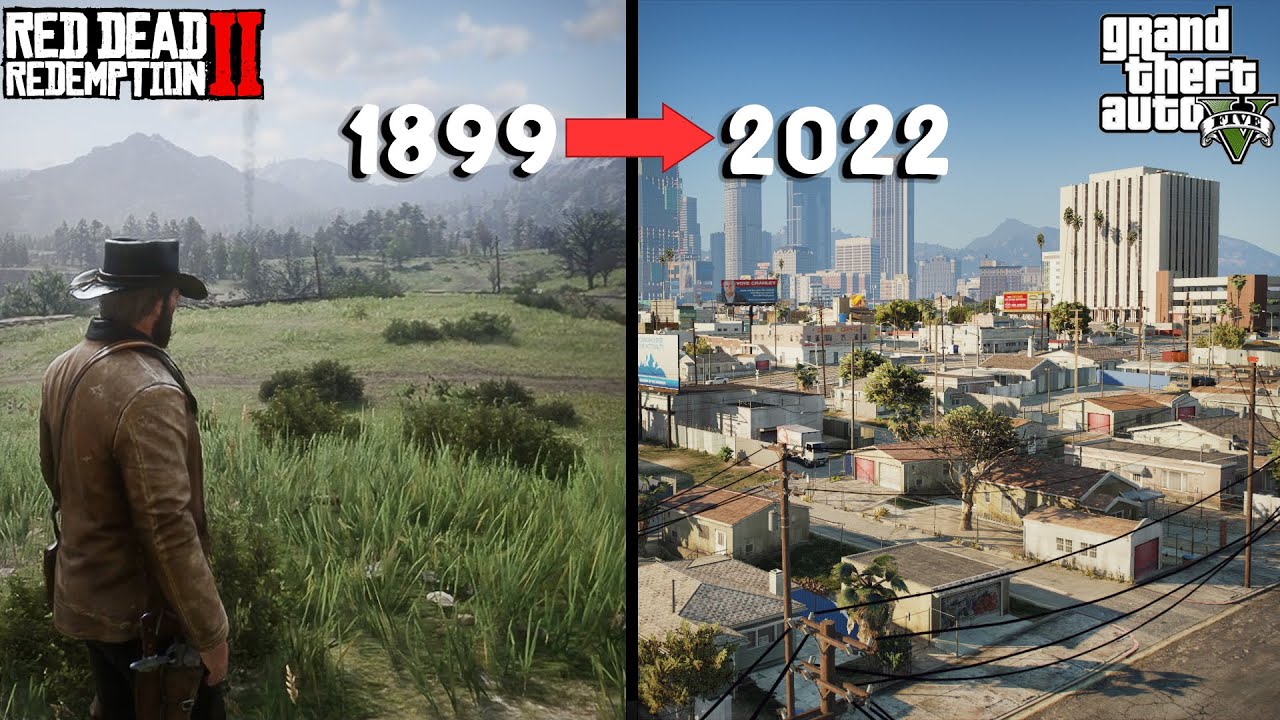
If you’ve ever argued about whether GTA or Red Dead is Rockstar’s best work, you’re already playing Rockstar’s favorite game: comparison as obsession. Because Rockstar doesn’t just ship “games.” It ships eras. Each release becomes a reference point that rewires how open worlds are judged.
But here’s the uncomfortable reality: GTA and Red Dead aren’t competing on the same battlefield. They’re two different philosophies built by the same studio—one obsessed with satire, speed, and chaos, the other built on silence, consequence, and soul.
So let’s do the comparison properly—from the early days to modern Rockstar—and answer the question that triggers fan wars faster than a five-star wanted level:
Did Rockstar peak with GTA… or did Red Dead quietly surpass it?
1) Rockstar’s “Two Universes”: Chaos vs Consequence
At a glance, Rockstar has two flagship identities:
- GTA: modern crime, satire, speed, systems that reward mayhem.
- Red Dead: historical tragedy, realism, slow immersion, emotional weight.
GTA is designed to make you feel like the city is a playground that fights back. Red Dead is designed to make you feel like the world is a living organism—and you’re just passing through it.
That difference shapes everything: mission design, pacing, NPC behavior, even how you remember the games years later.
2) Early Rockstar: When “Open World” Was a Dangerous Experiment
Before Rockstar became a myth, it was a studio learning how to build freedom without the world collapsing under it.
GTA’s Early Identity
Early GTA wasn’t about cinematic storytelling. It was about permission: permission to break rules, steal cars, and turn a simple objective into absolute chaos. The core appeal was immediate: you weren’t a hero—you were the problem.
Then the series hit its first true turning point: the shift into 3D. GTA didn’t just get bigger. It became a place—a city with traffic, routines, police escalation, radio culture, and neighborhoods that felt distinct even with limited hardware.
Red Dead’s Origin Story (The Underdog Era)
Red Dead didn’t start as Rockstar’s crown jewel. It started as something quieter: a Western action concept with a slower vibe and less mainstream certainty. And that’s exactly why it became so powerful later.
Because once Rockstar mastered open-world tools through GTA, it could finally build a Western world that didn’t feel like a set—it felt like a life simulation with a heartbeat.
3) The 3D Revolution vs The Western Renaissance
To understand Rockstar’s growth, you have to compare the two biggest “identity leaps” the studio made:
- GTA’s 3D era leap: the birth of the modern open-world city.
- Red Dead’s modern leap: the birth of the emotionally immersive open-world frontier.
GTA in the 3D Era: Iconic, Loud, Limitless
GTA’s 3D era didn’t just deliver big maps. It delivered personality:
- Vice-style energy: the city sells a fantasy—music, color, crime glamour.
- State-wide scale: multiple regions, shifting biomes, a “journey” feeling.
- RPG-like systems: customization, skills, territory, roleplay without calling it roleplay.
GTA became the ultimate “you can do anything” franchise. Even when missions were linear, the city around them felt open-ended.
Red Dead’s Rise: The Power of Silence
Red Dead’s genius is that it doesn’t chase constant excitement. It chases meaning. It uses:
- slower travel to make the world feel huge
- ambient encounters to make the world feel unpredictable
- quiet moments to make characters feel human
GTA often makes you laugh at society. Red Dead often makes you feel the weight of time. One is an explosion. The other is an echo.
4) Mission Design: Set Pieces vs Living Stories
Rockstar missions are famous for cinematic structure, but GTA and Red Dead use that structure differently.
GTA Missions: “Blockbusters You Can Break” 🚗
GTA missions are often engineered like action scenes. They are built for:
- high-speed chases
- heists, shootouts, chaos escalation
- comedy and satire beats
- variety (one mission is stealth, next is driving, next is pure insanity)
Even if the mission is strict, the world gives you space to improvise. GTA wants you to feel clever when you “solve” a problem your way.
Red Dead Missions: “Cinema With Consequences” 🐎
Red Dead missions often prioritize emotional pacing. Many missions are designed to:
- build relationships (trust, tension, loyalty)
- create atmosphere and dread
- make you feel like a moment mattered
- show the world’s moral complexity
In GTA, you’re usually pushing forward. In Red Dead, you’re often watching things fall apart in slow motion. That’s not “boring.” That’s intent.
5) World Design: The City as a Machine vs The Frontier as a Living Organism
This is where the comparison gets serious.
GTA Worlds: Dense, Loud, Reactive
GTA cities are designed for density. The magic is how much happens in a small space:
- traffic that creates chaos chains
- NPCs who react instantly to disruption
- police escalation that turns mistakes into stories
- radio chatter that gives the city a voice
GTA isn’t just open world. It’s open system. You poke it, and it pokes back.
Red Dead Worlds: Slow, Wild, Deep
Red Dead’s world is built on “presence.” It focuses on:
- natural behavior (animals, weather, wilderness rhythm)
- small encounters that feel personal
- a sense of distance and time
- believability over speed
In GTA, a street corner is a comedy stage. In Red Dead, a riverbank can feel like a memory.
6) Writing & Tone: Satire vs Tragedy (And Why Rockstar Needs Both)
People underestimate how much tone determines “best game” debates.
GTA’s Tone: The World Is a Joke (Until It Isn’t)
GTA thrives on parody: consumer culture, influencer obsession, corporate greed, media manipulation. It turns modern life into a mirror that’s just exaggerated enough to be funny—until you realize it’s not that exaggerated anymore 😬.
That satire gives GTA a superpower: it can stay culturally relevant because modern culture keeps producing new material for it.
Red Dead’s Tone: The World Is Ending Quietly
Red Dead is obsessed with endings: the end of the Wild West, the end of freedom, the end of a lifestyle, the end of illusions. It’s a story about people trying to outrun change—and losing.
That’s why Red Dead hits so hard emotionally. It doesn’t just entertain. It lingers.
7) The Real Rockstar Evolution: From “Fun” to “Believable”
If you zoom out, Rockstar’s history looks like a shift from “fun-first chaos” toward “believable worlds.”
Early GTA proved freedom could be fun. Later GTA proved freedom could be cinematic. Then Rockstar pushed realism and immersion further—and Red Dead became the perfect vehicle for that.
In other words:
- GTA taught Rockstar how to build systems.
- Red Dead taught Rockstar how to build life.
And that’s why the argument is so messy: you’re not comparing two games. You’re comparing two versions of Rockstar’s soul.
8) So Which One Is Rockstar’s “Best”? The Answer That Starts Wars 🔥
Here’s the truth fans don’t like because it refuses to pick a single winner:
- If you want maximum replay chaos, GTA wins.
- If you want maximum emotional impact, Red Dead wins.
- If you want the most culturally explosive phenomenon, GTA wins.
- If you want the most believable open-world immersion, Red Dead wins.
But if you force the question into one brutal line—which is Rockstar’s masterpiece?—the answer depends on what you believe “masterpiece” means.
GTA is Rockstar’s loudest triumph.
Red Dead is Rockstar’s deepest triumph.
One changes the industry by being the most playable chaos machine ever built. The other changes the industry by proving open worlds can deliver tragedy with the weight of a classic film.
Final Take: Rockstar’s Most Dangerous Advantage Is That It Can Be Two Studios at Once ✅
Most developers can do one “tone” well. Rockstar can do two extremes—and make both feel premium:
- the modern city as a satire engine (GTA)
- the frontier as a living tragedy (Red Dead)
And that’s why Rockstar comparisons never end. Because every time Rockstar releases something, it doesn’t just compete with other studios—it competes with itself.
If you came here expecting a simple “GTA is better” or “Red Dead is better,” Rockstar already won. Because you’re still thinking about it—and you will be thinking about it the next time a trailer drops. 😉

