It begins with a city that doesn’t know you.
No one cheers when you arrive. No one cares who you are. Traffic moves like blood through veins, strangers shout nonsense, sirens cut the air… and somewhere in that noise, Rockstar hands you a terrifying gift:
Freedom.
In 1997, Grand Theft Auto wasn’t “cinematic.” It wasn’t “prestige.” It wasn’t even trying to be loved. It was an experiment—almost a dare:
“What happens if we drop you into a city and let you do the worst things… and then we watch what you choose?”
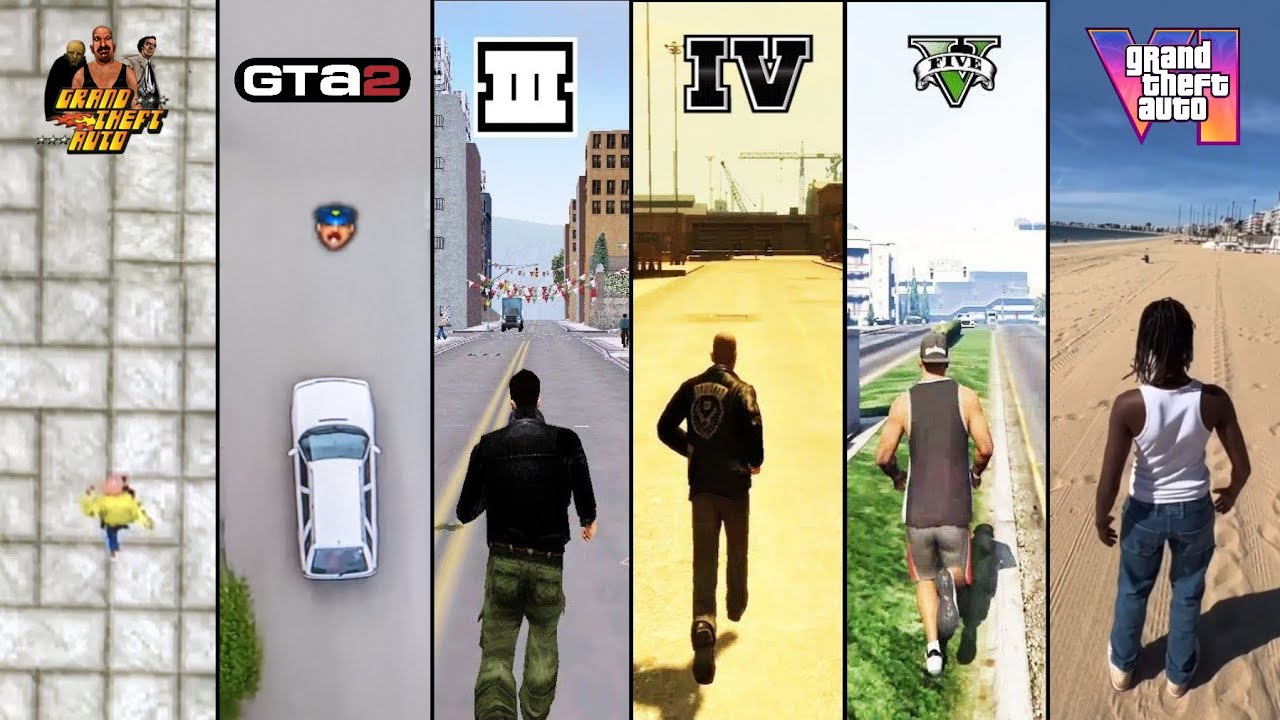
Now it’s 2026. GTA 6 is on the horizon. And if you trace the series from GTA 1 to GTA 6, you realize Rockstar didn’t just upgrade graphics. It upgraded the way you think inside a world.
This is the story of that evolution—told like a crime saga, compared like a technical autopsy, and written to expose the changes people argue about without understanding. 👀
1997: GTA 1 — When the Camera Looked Down… It Felt Like the City Looked Back
GTA 1 is easy to underestimate. Top-down view. Simple sprites. Brutal simplicity. But that’s exactly why it was dangerous: the game didn’t distract you with spectacle—it gave you permission.
In most 90s games, you were guided. Protected. Channeled.
In GTA 1, you were released.
The story wasn’t a movie. It was a mood: you’re a nobody in a hostile city, and the only “progression” is what you’re willing to do. The wanted system was primitive, but the tension was real: commit a crime, feel the world respond.
What changed here? GTA introduced the raw fantasy of urban freedom.
What it lacked? Character drama. Emotional arcs. It was crime as a sandbox, not crime as a story.
1999: GTA 2 — The Day GTA Learned Society Has Sides
GTA 2 didn’t just add missions—it added something more important: reputation.
Now the city wasn’t just “NPCs.” It was factions. Gangs. Systems that reacted differently depending on who you helped or betrayed. That small shift did something huge: it planted the seed that the world could feel political—not in ideology, but in consequence.
Suddenly, GTA wasn’t only about chaos. It was about relationships inside chaos.
What changed? The city began to “remember” your alignment.
What it still lacked? A cinematic narrative identity. GTA’s heart was growing, but it hadn’t found its voice yet.
2001: GTA III — The Door Opened… and Open Worlds Never Recovered
GTA III didn’t feel like a sequel.
It felt like an invasion.
When Liberty City went 3D, something happened that’s hard to explain to anyone who wasn’t there: games stopped feeling like levels and started feeling like places. GTA III wasn’t “big” by today’s standards, but it was alive. Cars had flow. Pedestrians had habits. Police had escalation. Radio stations had personality.
And suddenly, crime wasn’t an icon on a map. It was a scene you caused.
What changed? GTA became a cinematic city simulator.
What was lost? Some of the arcade simplicity of the early era—replaced by atmosphere and realism.
2002: Vice City — Crime Became Style (And Rockstar Found Its Swagger) 🌴
Vice City is where GTA stopped feeling like “a crime game” and started feeling like a time machine.
Rockstar didn’t just build missions; it built the 80s. Neon. Ego. Greed. Music that permanently rewired players’ nostalgia. Vice City’s secret was that its story and setting were inseparable: the rise-to-power fantasy only works because the city is seductive.
Tommy Vercetti’s journey wasn’t complex like a tragedy—it was iconic like a legend. And the world supported it with constant identity.
What changed? GTA learned that tone is a weapon.
What grew? Radio culture, cinematic pacing, and the feeling that the city itself is a character.
2004: San Andreas — Rockstar Didn’t Just Go Bigger… It Built an Entire Lifestyle 🏙️
San Andreas wasn’t a game you finished.
It was a game you lived in.
Three major cities. Vast countryside. Deserts, forests, highways, secrets. And on top of that, Rockstar added systems that made CJ feel like a living project: fitness, weight, skills, clothing, haircuts, territory control.
San Andreas was the moment GTA flirted openly with roleplay. It let you shape your character not only through choices, but through routine.
What changed? GTA became part RPG, part life sim, part crime epic.
What became legendary? Scale + variety + the “journey” structure—starting small and expanding into something massive.
2008: GTA IV — The Laughing Stopped. The City Turned Cold. 🌧️
GTA IV is the tonal whiplash that still divides the community.
After the bright madness of San Andreas, GTA IV arrived like rain on concrete: heavy, gray, realistic. Liberty City returned, but it wasn’t a playground anymore. It was a pressure cooker.
Niko Bellic’s story hit harder because it wasn’t about becoming a king—it was about surviving disappointment. The “American Dream” wasn’t a prize. It was bait. GTA IV’s world design supported that: driving felt weighty, physics felt physical, and violence felt less like a joke and more like an accident you couldn’t undo.
What changed? Rockstar proved it could do tragedy.
What fans still fight over? The realism. Some call it immersive. Others call it “too heavy.” Rockstar didn’t care. It committed.
2013: GTA V — The Blockbuster Era (Three Minds, One City, Infinite Chaos) 💥
GTA V didn’t try to be a single story.
It tried to be a machine of stories.
Three protagonists meant Rockstar could switch tones instantly: Michael’s polished crime drama, Franklin’s ambition, Trevor’s explosive unpredictability. The mission design became pure set-piece energy—heists, chases, cinematic moments—while the open world stayed flexible enough to create ridiculous emergent chaos.
But GTA V’s true superweapon was longevity: the foundation for an online ecosystem that kept the GTA universe culturally alive for years.
What changed? GTA became a modern entertainment platform, not just a game.
What shifted? Satire returned louder than ever—sometimes at the expense of emotional depth, by design.
2026: GTA 6 — The Final Mutation? (Why This One Could Break the Series Forever) 🚀
GTA 6 is different before it even launches—because it isn’t fighting other games. It’s fighting the legend of GTA itself.
Rockstar has already framed GTA VI as the “biggest, most immersive evolution” of the franchise, returning to Vice City in the state of Leonida. That matters because modern culture has become a living parody: viral crime clips, influencer chaos, absurd headlines. The world is already “GTA-coded.”
So Rockstar’s challenge isn’t just making a bigger map.
It’s making a world that feels smarter. More reactive. More alive. A city that doesn’t just respond—it adapts.
If GTA 6 pulls this off, it won’t just be the next GTA.
It will make every older GTA feel like a prototype.
The Brutal Comparison: What Actually Changed From GTA 1 to GTA 6?
- Freedom → Immersion: Early GTA gave you freedom. Modern GTA tries to make freedom feel believable.
- Chaos → Systems: The series moved from “do crimes” to “watch a living system react to your crimes.”
- Icons → Humans: Characters evolved from archetypes to emotionally complex protagonists (especially in GTA IV).
- Maps → Worlds: Cities stopped being layouts and became personalities with culture, satire, and memory.
- Story → Platform: GTA V proved Rockstar can build an ecosystem, not just a campaign.
- Next Step (GTA 6): A world that feels more responsive than ever—where the city itself is the ultimate antagonist.
The Ending Nobody Likes: Rockstar Didn’t Upgrade Graphics… It Upgraded You ✅
Here’s the real hard truth that makes the whole GTA timeline feel creepy in hindsight:
Every GTA game trained you.
GTA 1 trained you to break rules.
GTA 2 trained you to care about factions.
GTA III trained you to live in a city.
Vice City trained you to crave style.
San Andreas trained you to roleplay a life.
GTA IV trained you to feel consequence.
GTA V trained you to chase spectacle.
And GTA 6?
If Rockstar is really going “most immersive evolution”… it may train you to fear something new:
a world that notices you back. 😳

)