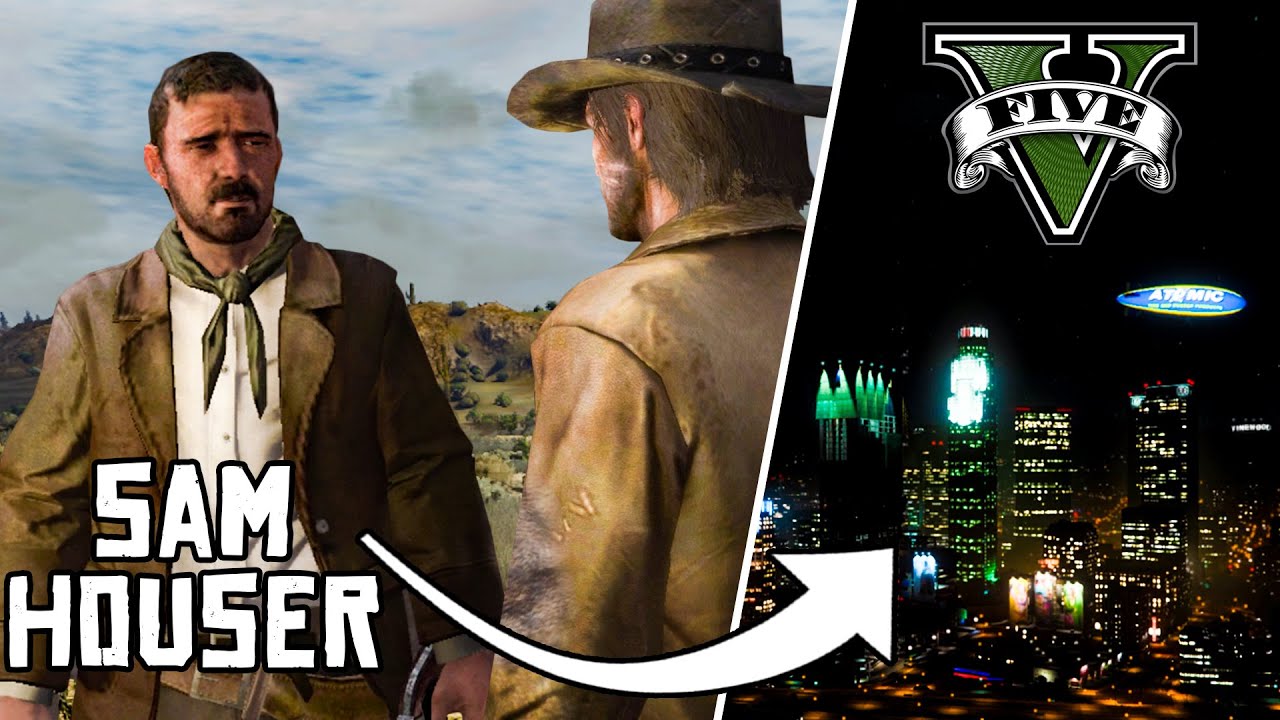
It started with a screenshot.
Not the kind you frame. Not the kind you brag about. The kind you delete because it looks too ordinary to matter—until you zoom in and realize it doesn’t belong in the world you’re staring at.
A blurry sign. A street name that shouldn’t exist. A texture that looks like it came from a completely different era. And one tiny symbol—barely visible—sitting in the corner like it was daring someone to notice.
I wasn’t supposed to care.
But if you’ve ever lived inside a Rockstar game—really lived inside it—you already know the rule: nothing is accidental. Not the radio ad you laughed at. Not the stranger you ignored. Not the cabin you found at 2AM when you were “just exploring.” Rockstar doesn’t build worlds. Rockstar builds traps.
And this one was bait.
The Hook: A GTA Clue That Didn’t Make Sense
The rumor was simple, almost stupid:
“There’s a Red Dead reference hidden in GTA that points to something bigger.”
I’ve heard versions of that for years. GTA fans are detectives with unlimited free time and questionable sleep schedules. Red Dead fans are worse—because they don’t just find secrets, they write poetry about them.
But this time, the screenshot was different.
It showed a GTA-style billboard: loud colors, cheap marketing, that classic Rockstar “this is a parody of your life” energy. The kind of thing you drive past a thousand times without registering.
Except the slogan was wrong.
It wasn’t funny. It wasn’t modern. It felt… old. Like it belonged to a different world. And under the main text, half-hidden by grime, there was a smaller line that looked like nonsense.
“LEMOYNE…”
My stomach actually dropped.
Lemoyne isn’t a word GTA throws around.
Lemoyne is Red Dead territory. Swamps. Heat. Mosquitoes. Ghost stories. A place where the air feels thick with secrets.
So why was it here—on a GTA billboard—like a glitch in reality?
The Chase: When Rockstar Fans Become Investigators
I did what every rational adult would do.
I ignored my responsibilities and went hunting.
First I revisited the places the screenshot claimed it came from. I checked angles. Lighting. Weather. I tried different times of day like I was conducting a crime scene investigation. I thought: maybe it’s an edited image. Maybe it’s a mod. Maybe it’s a prank.
But then I found it.
The billboard.
The same grime streaks. The same torn corner. The same weird, “not-GTA” slogan. And there it was again:
LEMOYNE.
I stared at it longer than I’m comfortable admitting. Because it wasn’t just a reference. It was placed too carefully. Like a breadcrumb that only obsessive fans would ever follow.
And that’s when the second part hit me:
Right below “LEMOYNE,” there was a symbol. A tiny mark that looked like a simplified stamp.
Not a logo.
A brand.
The kind you burn into a wooden crate.
The kind you hide on a shipping label.
The kind that says: this is cargo, and someone wants it moved quietly.
The Theory: GTA and Red Dead Aren’t Just “Connected”… They’re a Rockstar Experiment
People love to argue whether GTA and Red Dead share a universe. It’s a classic debate because Rockstar feeds it just enough to keep the fire alive.
But what if the truth is bigger than “same universe”?
What if Rockstar is doing something else—something scarier:
What if Rockstar is building a single Rockstar “meta-world” where themes, systems, and story DNA can cross-pollinate?
Think about it. GTA is the modern chaos machine. Red Dead is the slow-burn tragedy engine. Together, they represent Rockstar’s two extremes:
- GTA: satire, speed, crime-as-entertainment, modern madness.
- Red Dead: consequence, heartbreak, history, human weight.
Two genres. One studio. One obsession: making worlds feel alive.
If Rockstar ever fused the two philosophies—not the settings, but the design soul—you wouldn’t get “GTA with horses.” You’d get something entirely new.
Something that could make every open-world game feel outdated overnight.
The Moment Everything Changed: A Door That Shouldn’t Open
Here’s where it gets weird.
Because the billboard wasn’t the end. It was the beginning.
The rumor said there was a place you had to go next. A “nothing spot.” An area players ignore because there’s no mission marker, no treasure, no achievement.
I went anyway.
There was an old building on the edge of the map—one of those GTA structures that exists purely as scenery. No interior. No purpose. A throwaway asset.
Except the door wasn’t sealed the way these doors usually are.
It had a gap.
A thin, dark line like it could be pushed.
I walked up. Pressed the interaction button out of pure habit.
And the door opened.
I froze.
Not because it was a huge reveal. Not because there was treasure inside. The room was almost empty—just dust, a cracked table, and a few scattered items like someone left in a hurry.
No cutscene. No dramatic sting. Nothing.
That’s what made it terrifying.
Because it felt like something the game didn’t expect me to find.
On the table was a map.
Not a GTA map.
A rough, hand-drawn piece of paper with lines and scribbles like a frontier sketch.
And in the corner, stamped again, that same symbol.
The brand.
Then I saw the word written across the top in faded ink:
“BLACKWATER.”
I actually laughed. Like my brain didn’t know what else to do.
Blackwater is not a random word. Red Dead fans know what it means. It’s a location, a trauma, an unspoken wound in the timeline.
And now it was sitting in a GTA room like a message in a bottle.
Why This Feels Like Rockstar’s Biggest Trick (And Why It Works)
This is the part people miss when they talk about Rockstar secrets.
It’s not about whether the reference is “canon.” It’s not about whether GTA and Red Dead truly share a timeline. Rockstar doesn’t need that.
Rockstar is doing something more powerful:
They’re turning players into storytellers.
They create worlds so detailed and so consistent that your brain starts connecting dots automatically. You see patterns. You build theories. You invent explanations. You share them. You argue. You obsess.
Rockstar’s biggest content engine isn’t missions.
It’s mystery.
And mystery makes clicks.
Mystery makes communities.
Mystery makes a game feel alive years after release.
Because once you believe there’s something hidden, you never stop looking. 👀
The Twist: What If the “Missing Game” Isn’t a Game… but a Design Blueprint?
Here’s the theory that hit me on the drive home from my own obsession (yes, I went outside—barely):
What if Rockstar is using GTA and Red Dead as two halves of a long experiment?
- GTA perfects systems-driven chaos.
- Red Dead perfects immersion-driven consequence.
And the real “missing Rockstar game” is the one that merges those philosophies into one giant next-gen open world where:
- the city reacts like GTA, fast and vicious
- the world remembers like Red Dead, slow and permanent
- your choices have real emotional weight
- but the sandbox stays unpredictable and fun
Imagine a Rockstar world where you can still cause chaos—but the world doesn’t reset emotionally. Where NPCs don’t just forget. Where stories don’t just “end.”
That would be the most dangerous open world ever made.
The Ending You Won’t Like: Rockstar Already Won (Because You Read This Far)
If you clicked this expecting a simple answer—“yes they’re connected” or “no they’re not”—you’ve already fallen into the trap.
Because Rockstar’s real power isn’t in confirming theories.
It’s in making sure you never stop chasing them.
GTA is a mirror of modern madness. Red Dead is a funeral for an era. Rockstar stands between them like a magician who knows your brain better than you do.
And that’s why one billboard, one symbol, one door, and one faded word can hijack your attention for hours.
Not because it’s “proof.”
But because Rockstar made you believe the world has a secret.
So here’s the real question:
If this much obsession can be triggered by a single hidden reference… what happens when Rockstar finally decides to make the connection impossible to ignore?
Leave a Reply